Product Storytelling: the critical skill for the next stage of commerce
In a world of infinite shelf space and AI-driven discovery, product stories are infrastructure, not a marketing tactic.
In a world of infinite shelf space and AI-driven discovery, product stories are infrastructure, not a marketing tactic.
Mass Market Brands are Alive and Well, but the Mass Market is Over
Gochujang sauce is currently my youngest daughter’s favorite condiment. She covers most everything she eats with it, from her avocado toast at breakfast to her veggie kabab and rice at dinner.
My eldest’s favorite on any given day toggles between Japanese barbeque sauce and FYM, a small batch, local Portland hot sauce.
But those are just a small sample of the myriad flavors bursting from every shelf in our kitchen. A diversity that would be unimaginable to my own 80s-era, teen tastebuds. Like most households of the era, my parent’s kept a very tight condiment shelf: ketchup, yellow mustard, mayonnaise and maybe a bottle of A-1 if steak was on the menu that week.
And our kitchen is not unique. In fact, it’s a fairly accurate microcosm of today’s food and beverage industry writ large. It also illustrates the seismic shift the entire retail industry has been going through for the last two decades—from an era where mass markets and economies of scale were the sure path to success, to today’s long tail economy where products win by serving specific moments, contexts, and needs.
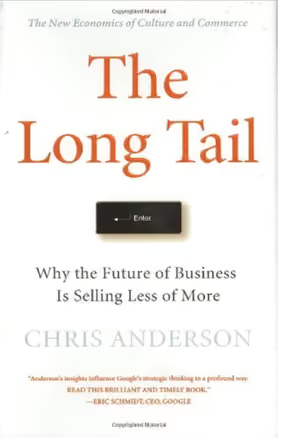
Long what? The Long Tail is a concept coined by Wired editor Chris Anderson in 2004 that describes how, in ecommerce with its low distribution and storage costs, the collective demand for many niche products can rival or exceed the demand for a small number of blockbuster products.
The mass market never reflected consumer preferences, it distorted them
For the last fifty years mass markets seemed like an immutable law of capitalism. It was simply assumed that, as consumers, we all shared the same affinity for a small handful of products and brands.
The truth is mass markets were never an accurate reflection of consumer preference. They were an artifact of a particular set of operational limitations consumer brands faced: physical retail, broadcast media and economies of scale.
Physical retail limited how many products could exist at all. Shelf space was scarce and expensive. Shoppers were constrained to the handful of stores they could reach by car in an afternoon and the handful of products those stores could fit on their shelves.
Broadcast media reinforced that sameness. High ad costs and limited channels meant we all saw the same messages from the same few brands, over and over again.
Economies of scale rewarded uniformity and punished variation. To grow profitably, brands compressed diverse preferences into broad averages.
That compression worked remarkably well for generations. It produced global categories, household brands and a quality of life unimaginable just a generation earlier.
Until ecommerce broke it.
The internet took a wrecking ball to the mass market
The first major crack appeared in 1994 in the form of a big yellow website.
Before Amazon, physical bookstores like Barnes & Noble might carry 150,000 titles at most. Every one of those books had to earn its place. Unsold inventory was a tax. If a book didn’t move, it disappeared.
Amazon changed that math overnight. By moving books out of stores and onto servers, it proved a simple but radical idea: you could make real money selling a little bit of everything, not just a lot of a few bestsellers. Products no longer had to justify a spot on a shelf. They just had to justify a row in a database.
Once that door opened, it never closed.
Within a few short years, the constraints that defined the mass market began to disintegrate. Distribution costs collapsed. Geography stopped mattering. Suddenly it was economically viable to sell products that would have never survived a meeting with a retail buyer at Home Depot or Walmart. Obscure books. Regional foods. Hyper-specific tools. Products made for someone, not everyone.
The long tail didn’t create new tastes. It revealed the ones that had always been there. As ecommerce spread, the same pattern repeated across category after category. Clothing. Beauty. Home goods. Food.
And once consumers could reach products that better matched what they actually wanted, the advantage of mass sameness started to quickly fade.
At the same time, the means of production were changing too. Brands no longer needed factories, fleets, or massive balance sheets. Manufacturing, packaging, logistics, and marketing could all be outsourced. A good idea and a clear point of view went a lot further than they used to. Very small brands could be very profitable selling to ever smaller consumer segments.
But while supply exploded and diversified, discovery lagged behind.
Most ecommerce sites still looked like digital versions of big box stores. Endless grids. Generic categories. Feature lists that flatten meaningful differences. Thousands, or millions, of products presented through the same mass-market lens the internet had just blown apart.
In other words, Amazon gave us infinite shelf space, but not infinite understanding.
Social media was a big step in the right direction. It helped brands find consumers, often very efficiently. But it did little to help consumers find the right products and brands. Feeds rewarded novelty and noise, not clarity.
Search engines helped, but only to a point. The SERP forced shoppers to squeeze messy, emotional, human needs into a few blunt keywords. If you couldn’t name what you wanted precisely, you probably wouldn’t find it.
Ecommerce’s infinite supply exposed the next bottleneck: discoverability.
And solving that bottleneck—helping people understand what a product is, who it’s for, and why it exists—is where the next era of retail really begins.
AI finishes the job ecommerce started
Ecommerce broke the shelf. Social media broke broadcast. AI is finishing the job they started.
For the first time, shoppers don’t have to translate intent into keywords a machine can understand. With AI-powered search tools like ChatGPT and Gemini, they can simply say what they mean.
Instead of typing “best running shoes,” they can ask for “a lightweight trail shoe for wide feet that works in a wet Pacific Northwest winter,” then ask several follow up questions before settling on a purchase.
Instead of clicking categories, they describe situations, constraints, and tradeoffs.
That shift is subtle, but profound.
Natural language lets people express motivation, context, values, and tradeoffs in a single request. It turns vague intent into something legible—not just to humans, but to machines. Demand no longer needs to be averaged, simplified, or aggregated to be visible. Micro-markets don’t just exist now. They can be identified and catered to.
But AI can only work with what it can actually understand.
If a product description says “durable running shoe,” an LLM has no way to infer that it performs especially well on wet trails, or that it was designed for wide feet, or that it’s a favorite among runners who spend their winters slogging through Pacific Northwest slush. Those nuances don’t exist to the model unless they’re written down.
In a world of AI-driven discovery, product storytelling isn’t just a marketing deliverable. It’s the raw material models use to decide which products belong in which moments. AI doesn’t infer meaning out of thin air—it surfaces what brands have taken the time to articulate.
Buh-bye Unique Selling Proposition.
This breaks another mass-market assumption: that products have a single, primary reason to buy.
For decades, brands organized themselves around the idea of the Unique Selling Proposition (USP). One product. One message. One dominant benefit. That made sense in an era of limited shelf space, limited media, and shared discovery.
It makes far less sense in a world of infinite shelf and personalized search.
The same product is now chosen by different people, for different reasons, in different moments, using completely different language. One customer buys a jacket for warmth on winter commutes. Another buys that same jacket for packability on weekend trips. A third buys it because it aligns with their values around sustainability. None of those reasons are wrong, and none of them are universal.
Differentiation becomes situational, not absolute.
Instead of a USP, a more useful mental model might be a personalized purchase intent: the specific mix of motivation, context, constraints, and values that drive a purchase in a given moment. Not who the customer is in general, but what they are trying to accomplish right now.
Now that most paths to purchase go through AI, growth doesn’t come from finding the one perfect message and shouting it louder than anyone else. It comes from covering more purchase intents, without exploding your SKU count or fragmenting your catalog.
You don’t need more products. You need better intent coverage.
This holds true even for a brand like Coca-Cola, a pioneer of the mass-market era. People reach for a Coke for different moments in summer than they do in winter. A six-pack serves a different need than a 30-case or a single can. And the role Coke plays in people’s lives in Germany isn’t the same as it is in the US. Your product stories should reflect all of these intents.
The new challenge for brands is that writing ten different intent-based stories for 1,500 different SKUs is humanly impossible. That’s the bottleneck Talkoot was designed to break.
Talkoot: Built for a world of infinite choice
We built Talkoot for today, when products don’t win because they have a single, perfect pitch—but because each product in your catalog can be understood from many angles, in many moments.
Talkoot helps brands surface all the real reasons people buy each product: the problems the product solves, the contexts it shows up in, the values it signals.
It turns that understanding into a web of product stories with the depth and range modern discovery requires—and makes it actionable, so the right shopper gets the right story in the right channel at the right moment.
Not louder product stories. Clearer, more resonant ones.
.avif)




Ready to
move faster ?
